

Insights




Stop Chasing Vanity Metrics: The Consultant's Guide to Google Ads that Actually Book Discovery Calls
![[HERO] Stop Chasing Vanity Metrics: The Consultant's Guide to Google Ads that Actually Book Discovery Calls](https://framerusercontent.com/images/3THKwfRFUInYFzpGAK7nni13s8.webp)
Your Google Ads dashboard looks impressive. High impressions. Strong click-through rates. Engagement is climbing month-over-month. And yet your calendar sits empty. You're spending thousands on campaigns that generate applause but zero discovery calls. The problem isn't the platform. It's the metric. Melbourne consultants don't need validation from strangers scrolling LinkedIn during lunch breaks. They need qualified prospects who book calls, show up prepared, and convert into billable hours. Vanity metrics feel productive. Commercial metrics are productive. Here's how to stop chasing likes and start booking revenue.
The Problem: The 'Vanity Metric' Trap and the Invisible Professional Syndrome
You're measuring the wrong outcome. Impressions tell you how many people saw your ad. Clicks tell you how many were curious enough to click. Neither reveals whether a single prospect actually booked a discovery call. A campaign generating 10,000 impressions and a 4% CTR can produce zero qualified leads if your landing page doesn't convert or your targeting attracts tyre-kickers instead of decision-makers. The research confirms it: acceptable cost-per-lead metrics can mask campaigns that overpay for poor-quality leads while missing high-intent prospects entirely. You're optimising for visibility when you should be optimising for conversion. The 'Invisible Professional' syndrome strikes again: your ads reach thousands, but the prospects who matter most never see you because your targeting prioritises volume over intent. High impressions don't pay invoices. Discovery calls do.
The Strategy: Building a High-Intent Lead Generation Engine

Google Ads outperforms Meta for high-intent professional services because it captures active search behaviour, not passive scrolling. When a CEO in Richmond searches "strategy consultant Melbourne," they're in problem-solving mode. When they scroll Instagram, they're in distraction mode. The Trust Loop for consultants follows a predictable path: Trigger (search query) → Validation (ad copy that mirrors their exact pain point) → Vetting (landing page that demonstrates expertise). Your Google Ads infrastructure needs three layers. First, keyword selection that targets commercial intent, not informational browsing. "Strategy consulting services Melbourne" converts. "What is strategy consulting?" doesn't. Second, landing pages are built for conversion, not brand storytelling. Third, conversion tracking that measures discovery call bookings, not just form submissions. A lead who downloads a whitepaper isn't the same as a lead who books a paid consultation. Conversion rate becomes your diagnostic tool. High CTR with low conversion rate signals a landing page problem. Low CTR with a high conversion rate signals a targeting problem. Cost-per-lead and lead quality work together: one qualified discovery call is worth fifty unqualified enquiries.
The Implementation: Three Systems That Turn Clicks Into Booked Calls
Step 1: Keyword Selection That Targets Decision-Makers, Not Researchers
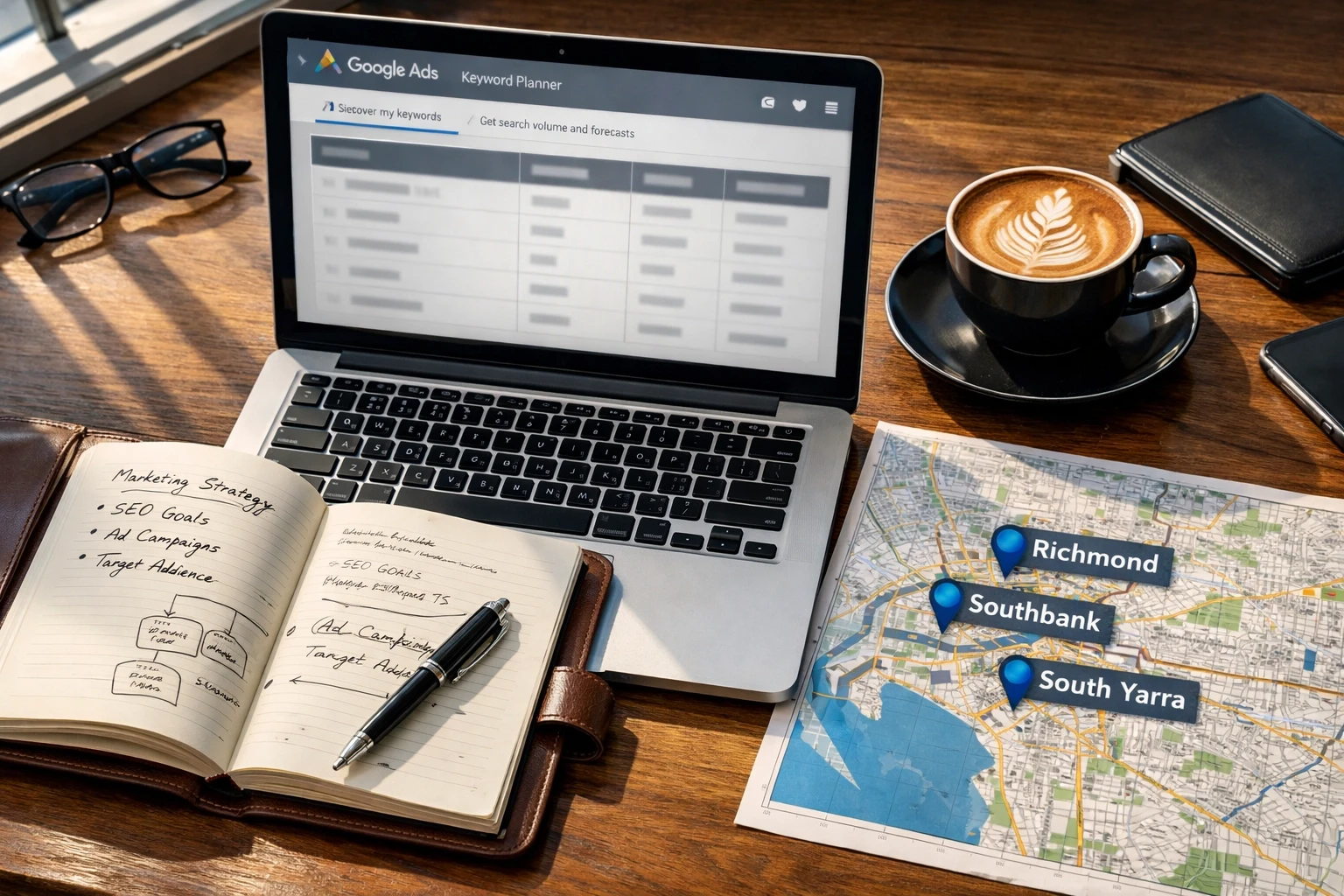
Your keyword strategy determines whether you attract prospects ready to hire or students researching a uni assignment. Focus on high-intent commercial phrases that signal budget and urgency. "Management consultant Melbourne pricing" beats "management consulting tips." "Hire strategy consultant Richmond" beats "strategy consultant blog." Use exact match and phrase match to control who sees your ads. Broad match attracts volume; exact match attracts intent. Layer location targeting to prioritise Melbourne suburbs where your ideal clients operate: Southbank, Docklands, South Yarra. Exclude negative keywords ruthlessly. Add "free," "cheap," and "DIY" to your negative list immediately. Filter out job seekers by excluding "jobs," "salary," and "career." Every irrelevant click burns budget that could have reached a CFO in Toorak searching for M&A advisory.

Step 2: Landing Pages Built for Trust Signals, Not Brand Theatre
Your landing page has one job: convert the click into a booked discovery call. Strip out everything else. No manifesto. No team bios. No client logo grids. Start with a headline that mirrors the search query exactly. If they searched "business transformation consultant Melbourne," your H1 should read "Business Transformation Consulting in Melbourne." Include three trust signals above the fold: your professional credentials (MBA, 15 years corporate strategy experience), a specific outcome you deliver (saved clients $2.4M in operational costs), and social proof (testimonial from a named Melbourne CEO). Your call-to-action must remove friction. "Book a 30-Minute Discovery Call" converts better than "Contact Us" because it's specific and time-bound. Use calendar integration so prospects can book immediately instead of waiting for email replies. Include a phone number for prospects who prefer voice.
Step 3: Conversion Tracking That Measures Revenue Outcomes, Not Activity
Set up conversion tracking that measures discovery call bookings, not just landing page visits or form submissions. A form submission is a lead. A booked discovery call is a qualified lead. The difference determines ROI. Use Google Ads conversion tracking to attribute bookings back to specific keywords and ads. Track three metrics weekly: conversion rate (clicks to bookings), cost-per-lead (ad spend divided by booked calls), and lead quality (percentage of discovery calls that convert to proposals). If your conversion rate drops below 3%, audit your landing page. If cost-per-lead exceeds your target client value, tighten keyword targeting. Calculate return on ad spend by tracking revenue from clients acquired through Google Ads. A $5,000 monthly ad spend that generates two clients worth $50,000 each delivers a 20x ROAS.
The Bottom Line: Billable Hours Over Applause Metrics
Melbourne consultants don't bill clients for LinkedIn likes or ad impressions. You bill for expertise, delivered during client engagements booked through discovery calls. Your Google Ads strategy should reflect that commercial reality. High-intent keywords attract decision-makers in problem-solving mode. Trust-signal landing pages convert clicks into bookings. Conversion tracking reveals what's working and what's not. The vanity metric trap is seductive because it feels productive. But a campaign generating 50,000 impressions with zero discovery calls is a failure, no matter how impressive the dashboard looks. Focus on commercial metrics: conversion rate, cost-per-qualified-lead, and return on ad spend. One booked discovery call with a Richmond CEO beats 10,000 impressions from people who'll never hire you.
If your Google Ads campaigns are generating clicks but not discovery calls, you're optimising for the wrong outcome. Book your Digital Growth Diagnostic & Action Plan ($99), and we'll audit your keyword strategy, landing page conversion signals, and tracking infrastructure to identify exactly where qualified leads are leaking out of your funnel.